

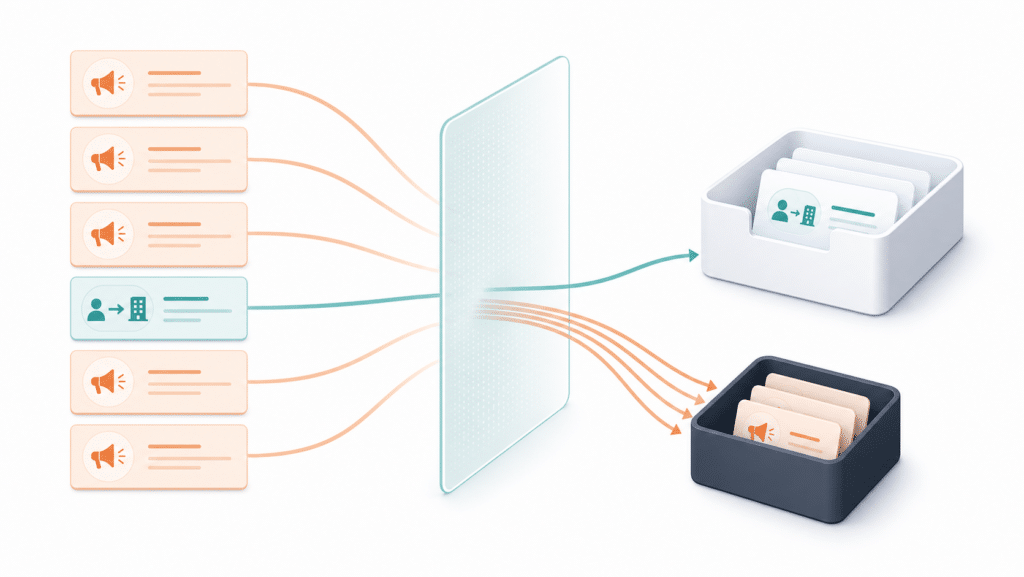
The worst Gravity Forms spam does not look like spam anymore.
It uses a plausible name. The email address works. The message mentions something from the page. It passes CAPTCHA, submits cleanly, and lands in a real person’s inbox looking just credible enough to steal a few minutes.
At TotalWeb Partners, the campaigns that pushed us to act were already getting past CAPTCHA and ordinary form checks. Adding a harder puzzle for every visitor would have punished the people our clients wanted to hear from. We now use Sentient Forms Spam Detection to review accepted submissions before they reach staff.
The form still behaves normally for the visitor. Behind the scenes, the workflow holds delivery long enough to decide whether a message deserves a person’s attention.
The visitor does not get a lesson in evasion.
TotalWeb Partners
Why CAPTCHA was no longer enough
CAPTCHA answers one narrow question. Does this interaction resemble the behavior the CAPTCHA system expects?
That is useful. It does not tell us whether a polished submission is an unsolicited sales pitch, link-placement request, fake service inquiry, malicious message, or legitimate prospect.
Some of the junk reaching our clients was written to survive simple rules. Blocking a phrase or disposable email domain would catch one campaign and miss the next. Tightening those rules too far would also catch terse but legitimate messages.
We needed to judge the submission in context. What is this form for? What does a real customer usually ask? Is the sender responding to the business on the page, or using generic language that could have been sent to anyone?
What 107 live decisions showed
We checked one industrial client’s production quote form across a 49-day span, from July 2 through August 20, 2026. We anonymized the client and reviewed aggregate records only.
107 decisions
Successful structured Sentient Forms classifications.
27 flagged
Spam or likely-spam results, equal to 25.2 percent.
33 held
Entries in the native Gravity Forms spam folder.
| Sentient Forms result | Count | Operational meaning |
|---|---|---|
| Legitimate | 80 | The workflow released the normal path. |
| Spam | 19 | The entry entered the configured spam path. |
| Likely spam | 8 | The entry also entered the configured spam path. |
Gravity Forms and Sentient Forms agreed on 24 flagged submissions. Another spam layer held nine entries that Sentient Forms classified as legitimate. Three Sentient Forms flags were outside the current native spam folder. The disagreement is useful because it shows why we do not ask one classifier or CAPTCHA score to carry the whole defense.
Every one of the 27 flagged entries carries a Sentient Forms classification note. The production workflow was configured to hold notifications during the background decision and suppress them for spam results. None of the 27 has a recorded “marked not spam” or restoration event. The workflow also uses 11 stored classification-guidance examples.
What these records do not prove
The entry screens do not independently record whether each staff notification was delivered, and the audit trail does not prove that a person manually reviewed all 107 decisions. We therefore cannot claim that every suppression executed or calculate a formal false-positive or false-negative rate from this cohort.
The quiet response is part of the defense
Our client-side setup does not announce, “We caught your spam,” and it does not expose the reason for the decision. The visitor gets the normal submission experience. The review happens behind the form.
A rejection message can become free quality assurance for the sender. It tells them the address, wording, or behavior that triggered the filter. Silence gives them less information to use on the next attempt.
We also do not publish our scoring cues, client examples, thresholds, or niche-specific patterns. That detail would be more useful to the sender than to a prospective customer.
We calibrated it instead of pretending it was perfect
No honest spam system can promise zero false positives and zero false negatives. We will not make that claim.
Sentient Forms returns a structured decision with a classification, confidence, justification, and indicators. That gives our team something better than a black-box yes or no. We can inspect why an entry was held, restore a legitimate inquiry, and find a spam message the first pass missed.
- Review suspicious and held entries during the early rollout.
- Identify false positives and false negatives instead of assuming the first settings are correct.
- Label representative entries as legitimate or spam and preserve the reason.
- Refine the site’s instructions and threshold without exposing that logic to the submitter.
- Continue spot checks because spam campaigns change faster than static rule lists.
The result is less interruption, not a more hostile form
The easy response to spam is to put more friction in front of everyone. Harder challenges, extra fields, and more validation errors all give a real prospect another reason to leave.
We wanted the opposite. Keep the form easy for a human with a genuine reason to contact the business. Move the difficult work behind the submit button.
Sentient Forms keeps the workflow visible in WordPress, where staff can review what happened instead of trusting an unexplained remote verdict. The broader Sentient Forms Action Library can summarize entries, score leads, and recommend routing after a submission survives the first review.
Teams can also add AI review to existing WordPress forms without starting over. For the implementation sequence, read our companion guide to a quiet Gravity Forms spam workflow.
Questions clients ask us
Does Sentient Forms replace CAPTCHA?
No. CAPTCHA and honeypots still catch inexpensive automated noise. Sentient Forms adds a contextual review layer for submissions that pass those mechanical checks.
Does the sender know the entry was flagged?
Not in the quiet workflow described here. The visitor receives the site’s normal completion experience while the review and delivery decision happen behind the form.
Can this guarantee that no real inquiry is held?
No. That is why TWP reviews early results, keeps reasons with classifications, and refines examples and thresholds for the specific form.