

The Search Happens Before the Click
Search still uses the web’s familiar foundations. AI now adds a layer that finds, compares, and organizes information before many people choose a link.
For years, being found online meant earning a place on a search results page, then persuading a person to click. That journey still exists. But it is no longer the whole journey. Search engines and AI assistants can now gather information, compare sources, and assemble a response before the person sees all the underlying pages.
Our earlier article, “How AI Is Redefining Web Visibility,” described the move from a list of links toward answers. The next chapter is how those answers are built: AI adds new layers of discovery on top of search technology, and it can draw on information well beyond a conventional website.
1. Search gained an answer layer
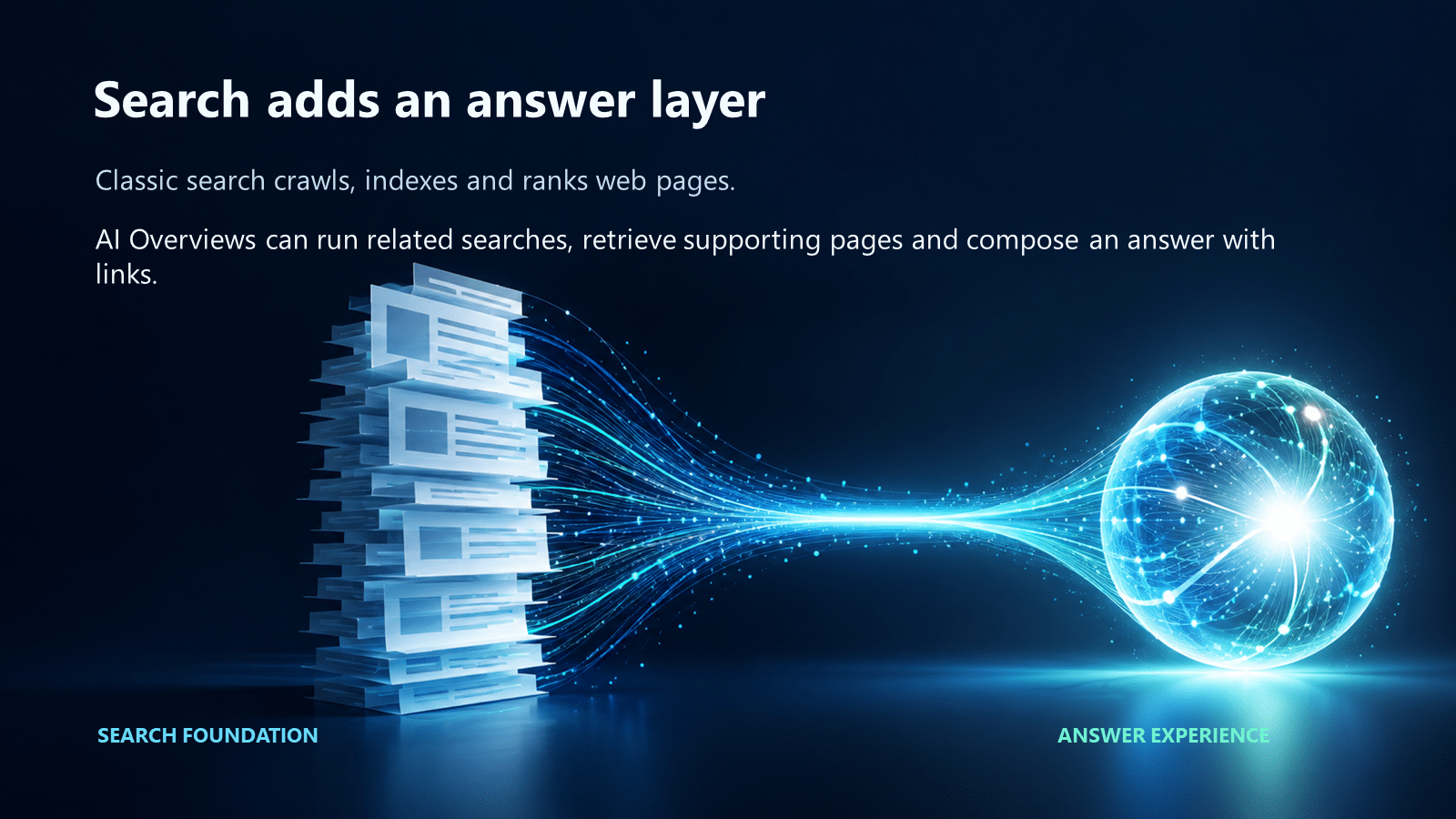
Traditional search collected and ranked pages. The user did the final sorting: open several results, decide which sources were credible, and piece together an answer. AI Overviews can perform some of that work inside the results page. Google’s documentation says its AI features rely on core Search systems and may issue several related searches across subtopics and data sources before producing a response.
That changes the moment of competition. A page may still rank and earn a visit, but its facts may first be evaluated alongside other sources for an answer the user reads immediately. Clear, accessible information helps the system understand what a business offers, where it operates, and why its content is relevant.
2. The timeline shifted the work from user to system
In 2024 and earlier, most search journeys still asked people to review a results list themselves. Google launched AI Overviews in the U.S. in May 2024 and expanded them to more than 100 countries and territories by late October. Microsoft introduced Copilot Search in Bing in April 2025, combining familiar search results with AI-generated answers.
By mid-2025, the click impact was visible in user behavior. In one Pew Research Center study of U.S. adults’ March 2025 browsing, people clicked a traditional result in 8% of Google visits that showed an AI summary, versus 15% without one—roughly 47% fewer clicks in those sampled visits. That comparison does not mean Google traffic fell by half overall, and it does not prove the summary alone caused the difference. Google later reported that aggregate organic click volume was relatively stable year over year.
The durable change is the sequence: the system increasingly sorts and summarizes first; the person then decides whether to click, ask a follow-up question, or act on the answer.
3. Assistants can search while they answer

A language model does not automatically know what changed this morning. When an assistant has search or retrieval tools, it can look for current information while answering. ChatGPT Search, for example, may rewrite a person’s question into more targeted searches and use search providers to find relevant material.
The discovery surface is wider than ordinary web pages. Depending on the product and the user’s permissions, an assistant may encounter product feeds and structured product details, business listings, partner content, and connected files or services. An agent may repeat the search as it compares options or completes a task. The exact sources and steps vary by system and request.
“Which local provider can deliver this service next week and support this equipment?”
The assistant requires: service description, verified location, availability calendar, compatibility documentation, and credible supporting evidence. A generic home page is unlikely to answer that whole question by itself.
4. Structured data helps facts travel

Structured data gives search systems explicit clues about what a page means: this is an organization, a service, a product, a location, or an FAQ. It works best when it accurately reflects information a visitor can also read on the page. Keep product and service feeds, business profiles, and other public records current and consistent.
This is a visibility discipline, not a magic tag. Google says there is no special schema required for its AI features, and markup does not guarantee a citation. But when essential facts are missing, buried, inaccessible, or contradictory, an AI system has less reliable material to find and use. In a specific search, that can make a business effectively invisible.
Make your business easy to find—and easy to understand
Start with the questions customers actually ask. Check whether each answer is stated plainly on a crawlable page; whether names, locations, services, products, and availability agree across your site, feeds, and profiles; and whether structured data describes the same visible facts. Then keep those facts current as offerings change.
Search has not abandoned links. It has added a stage of interpretation before many links are chosen. Businesses that make their information clear and consistent give both people and AI systems a better chance to find the right answer.